Tabea Zimmermann, Javier Perianes and Jean-Guihen Queyras come together with Brahms, Schumann and Joachim in a new album.
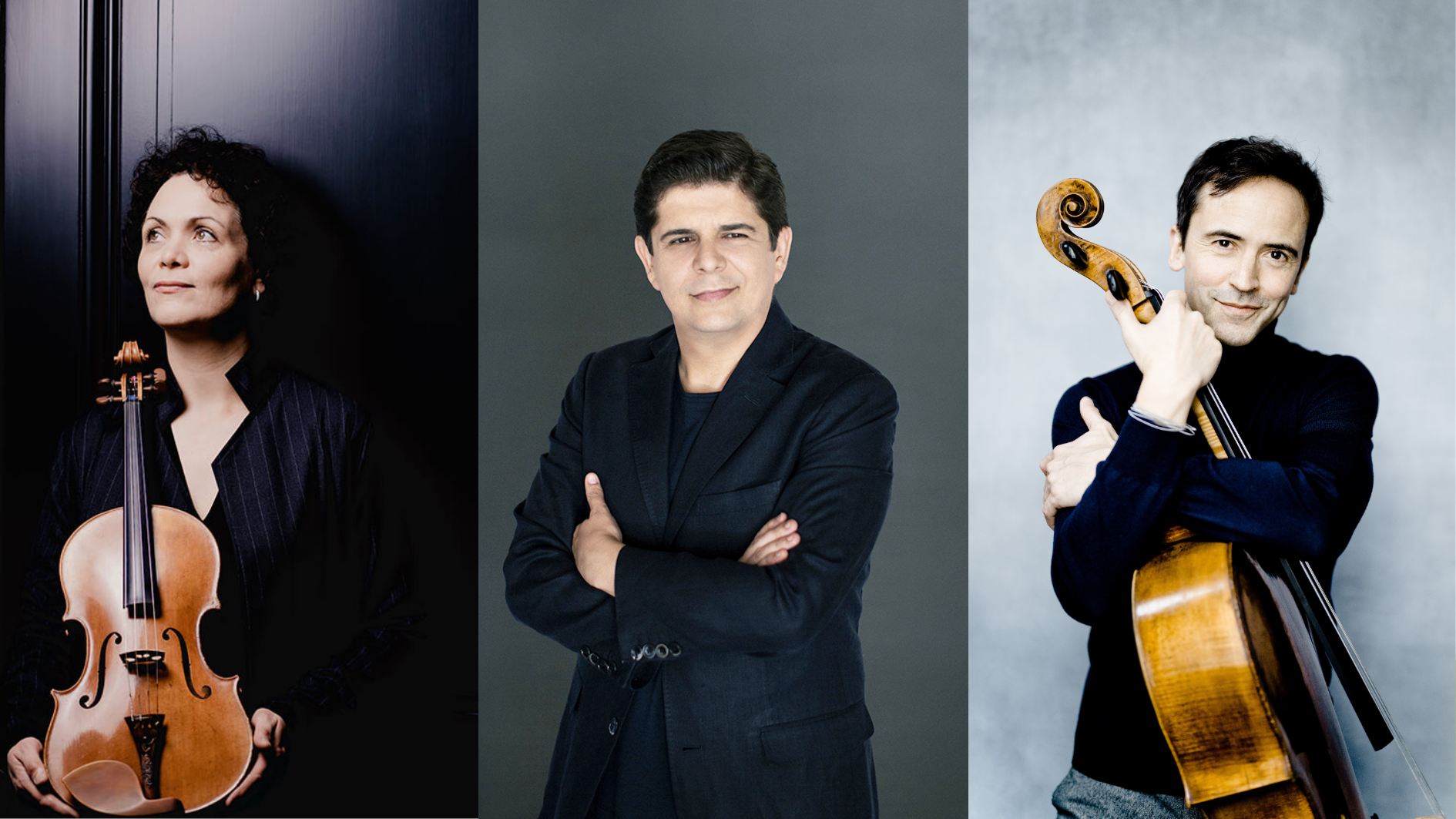
As of March 13, the new album by Tabea Zimmermann, Jean-Guihen Queyras and Javier Perianes on Harmonia Mundi is available. It includes works by Robert Schumann, Clara Wieck, Joseph Joachim and Johannes Brahms, exploring the special musical and personal universe of these four essential figures in the history of music.
The new album revolves around friendship, artistic affinity and shared musical creation, particularly that which developed within the circle formed by Brahms, the Schumanns and Joseph Joachim. These friendships, which emerged around 1853, profoundly shaped the lives of those involved and gave rise both to specific collaborations and to shared aesthetic ideals. In much the same way, Tabea Zimmermann, Jean-Guihen Queyras and Javier Perianes have met at different moments in their lives and have collaborated for several years, continuing this same idea of artistic affinity.
The decisive moment for that historical circle came when Brahms, only twenty years old, appeared at the Schumanns’ home just one week after the visit of the violinist Joachim, whom he had already known for several years. Robert Schumann immediately recognised the young composer’s talent and supported him enthusiastically, as much as his illness allowed.
A direct result of this bond was the F. A. E. Sonata (Frei aber einsam), a collective work written for Joachim and composed by Albert Dietrich (first movement), Robert Schumann (Intermezzo and Finale) and Brahms (Scherzo).
Clara Schumann’s Three Romances, Op. 22, were composed in 1853 and dedicated to Joachim. Together with the Six Lieder, Op.23, they are among the last works in her catalogue. Robert Schumann, for his part, composed his Three Romances, Op.94 in 1849 as a Christmas gift for his wife Clara. Originally conceived for oboe, they are now also performed with clarinet, violin, cello or viola.
Joachim’s Hebrew Melodies for viola and piano, Op. 9, composed between 1854 and 1855, take as their reference the collection Hebrew Melodies by Lord Byron (1815), consisting of thirty poems supposedly written from pre-existing melodies attributed to Isaac Nathan. These pieces contain stylistic elements that evoke both Brahms and Schumann.
As for Brahms’s Trio Op. 114, it was composed in 1891 after the composer’s visit to Meiningen, where he met the clarinettist Richard Mühlfeld, whose artistry deeply captivated him. Brahms immediately began work on this piece, which was followed by the Clarinet Quintet Op.115 and the two Clarinet Sonatas Op.120, both dedicated to Mühlfeld. The viola versions of the trio and the sonatas appear to have arisen mainly for practical reasons.